
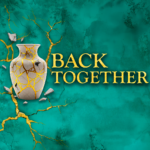

This series has described four people who were “broken” in some way before God put their pieces back together. They were more fulfilled and full of His glory after His work of restoration. (Kintsugi)
- Week 1 — Hannah – Restored to Fruitfulness (Mother of Great-Prophet)
- Week 2 — Mephibosheth – Restored to Dignity (Place at the King’s Table)
- Week 3 — Matthew – Restored to the Family of God (Apostle of Jesus)
- Pastor Kevin has pointed to the reality each week that the overarching narrative of all of Scripture is our Creator God seeking to restore us and all of creation in right relationship to Himself.
- Ruth in a Nutshell:
- The name Ruth is found in the Old Testament only in the book which is so entitled.
- Ruth is an interesting book in that God isn’t mentioned specifically by the narrator, yet the restoring/redemptive providential hand of God is obvious throughout the story
- The Book of Ruth details the history of the one decisive episode owing to which Ruth became an ancestress of David and of the royal house of Judah.
- The history lies in the period of the Judges (Ru 1:1), at the close of a great famine in the land of Israel. Elimelech, a native of Bethlehem, had, with his wife Naomi and two sons, taken refuge in Moab from the famine.
- Ruth 1:1, 3-5
- In the days when the judges ruled, there was a famine in the land. So a man from Bethlehem in Judah, together with his wife and two sons, went to live for a while in the country of Moab.
- 3 Now Elimelek, Naomi’s husband, died, and she was left with her two sons. 4 They married Moabite women, one named Orpah and the other Ruth. After they had lived there about ten years, 5 both Mahlon and Kilion also died, and Naomi was left without her two sons and her husband.
- Ruth 1:16-17
- “Where you go I will go, and where you stay I will stay. Your people will be my people and your God my God. Where you die I will die, and there I will be buried. May the LORD deal with me, be it ever so severely, if anything but death separates you and me.”
- Ruth demonstrates—loyalty—faith—devotion
- Ruth 1:19-22
19 So the two women went on until they came to Bethlehem. When they arrived in Bethlehem, the whole town was stirred because of them, and the women exclaimed, “Can this be Naomi?” 20 “Don’t call me Naomi,” she told them. “Call me Mara, because the Almighty has made my life very bitter. 21 I went away full, but the Lord has brought me back empty. Why call me Naomi? The Lord has afflicted me; the Almighty has brought misfortune upon me.
”So Naomi returned from Moab accompanied by Ruth the Moabite, her daughter-in-law, arriving in Bethlehem as the barley harvest was beginning.
- DID YOU MISS THAT?
- Naomi says, “I came home empty.”
- And the very next thing Scripture tells us is:
- “The barley harvest was beginning.”
- Ruth 2:20
- 20 “The Lord bless him!” Naomi said to her daughter-in-law. “He has not stopped showing his kindness to the living and the dead.” She added, “That man is our close relative; he is one of our guardian-redeemers.
- The kinsman-redeemer is a male relative who, according to various laws of the Pentateuch, had the privilege or responsibility to act on behalf of a relative who was in trouble, danger, or need.
- The Hebrew term (go el) for kinsman-redeemer designates one who delivers or rescues (Genesis 48:16; Exodus 6:6) or redeems property or person (Leviticus 27:9–25, 25:47–55).
- Ruth 3:7-11
- 7 When Boaz had finished eating and drinking and was in good spirits, he went over to lie down at the far end of the grain pile. Ruth approached quietly, uncovered his feet and lay down. 8 In the middle of the night something startled the man; he turned—and there was a woman lying at his feet! 9 “Who are you?” he asked. “I am your servant Ruth,” she said. “Spread the corner of your garment over me, since you are a guardian-redeemer of our family.” 10 “The Lord bless you, my daughter,” he replied. “This kindness is greater than that which you showed earlier: You have not run after the younger men, whether rich or poor. 11 And now, my daughter, don’t be afraid. I will do for you all you ask. All the people of my town know that you are a woman of noble character.
- Ruth humbly followed Naomi’s guidance and lay at Boaz’s feet at the threshing floor, a symbolic request for protection and redemption.
- Ruth 4:8-10
- 8 So the guardian-redeemer said to Boaz, “Buy it yourself.” And he removed his sandal. 9 Then Boaz announced to the elders and all the people, “Today you are witnesses that I have bought from Naomi all the property of Elimelek, Kilion and Mahlon. 10 I have also acquired Ruth the Moabite, Mahlon’s widow, as my wife, in order to maintain the name of the dead with his property, so that his name will not disappear from among his family or from his hometown. Today you are witnesses!”
- Removing his sandal was a guarantee the transaction was complete.
- Ruth 4:13-17
- So Boaz took Ruth and she became his wife. Then he went to her, and the LORD enabled her to conceive, and she gave birth to a son. The women said to Naomi: “Praise be to the LORD, who this day has not left you without a kinsman-redeemer. May he become famous throughout Israel! He will renew your life and sustain you in your old age. For your daughter-in-law, who loves you and who is better to you than seven sons, has given him birth. 16 Then Naomi took the child in her arms and cared for him. 17 The women living there said, “Naomi has a son!” And they named him Obed. He was the father of Jesse, the father of David.
- Obed was the father of Jesse, who was the father of David.
- This lineage is significant because David was chosen by God to be king of Israel, and from his descendants came Jesus Christ, the Messiah—Our Savior and King
- In the economy of God, restoration means you are more than before.
- There is no formula to escape pain and brokenness
- There is no prescription
- BUT there is a Person
- The Redeemer and Restorer
- Christ Jesus
- The Book of Ruth ultimately points to Christ, the true Redeemer, who welcomes all who come to Him in faith.
- Jay Wolf says:
- “The story of kintsugi—this style of pottery—may be the most perfect embodiment of all our trauma-shattered lives… Instead of throwing away the broken beloved pottery, we’ll fix it in a way that doesn’t pretend it hasn’t been broken but honors the breaking—and more so, the surviving—by highlighting those repaired seams with gold lacquer. Now the object is functional once again and dignified, not discarded. It’s stronger and even more valuable because of its reinforced, golden scars.”